The experiment
For decades everyone assumed seaweed worked because of the minerals in it. Researchers at Virginia Tech tested that directly. They took a seaweed extract, burned it down to ash so only the minerals were left, and applied both the ash and the whole extract to turf.
The ash did nothing. The intact extract raised the plant's own cytokinin levels 28 to 39% and its antioxidant activity 41 to 59%.
Kelp isn't feeding the plant. It's signalling it.
It switches on hormone pathways and stress defenses the plant already had, before the stress arrives.
Which tells you exactly when to use it
If kelp works by waking up stress defenses, it should do the most on plants under stress. That's precisely what the trials show.
In maize, the yield response went from 13.5% well-watered to 36.4% under severe drought. In a turf trial, kelp improved quality under drought and salt and did nothing at all under normal irrigation.
Transplants. Containers that dry out. August. Anything working hard. That's where the bottle earns its money. On a comfortable, well-fed plant in good soil, expect less.
The size of it, honestly
Three independent meta-analyses, one covering 2,021 comparisons, one 73 field studies, one 180, all land between 15% and 17% average response. Vegetables do best, around 20 to 23%. Soil drench beats foliar spray.
That's a real effect, and it's a modest one. Anyone promising more than that is ahead of the evidence.
What it won't do
- It won't replace fertilizer.Used instead of nutrients, seaweed cut cucumber yield by as much as 62%.
- It won't control lawn disease.No peer-reviewed field trial supports that claim.
- It won't do much in one week.Kelp works across a season, next to real feeding.
Why we print our number
When researchers tested twenty commercial seaweed extracts, they found a 60-fold range in active compounds and pH anywhere from 3.8 to 10.7. Same label language, very different jugs.
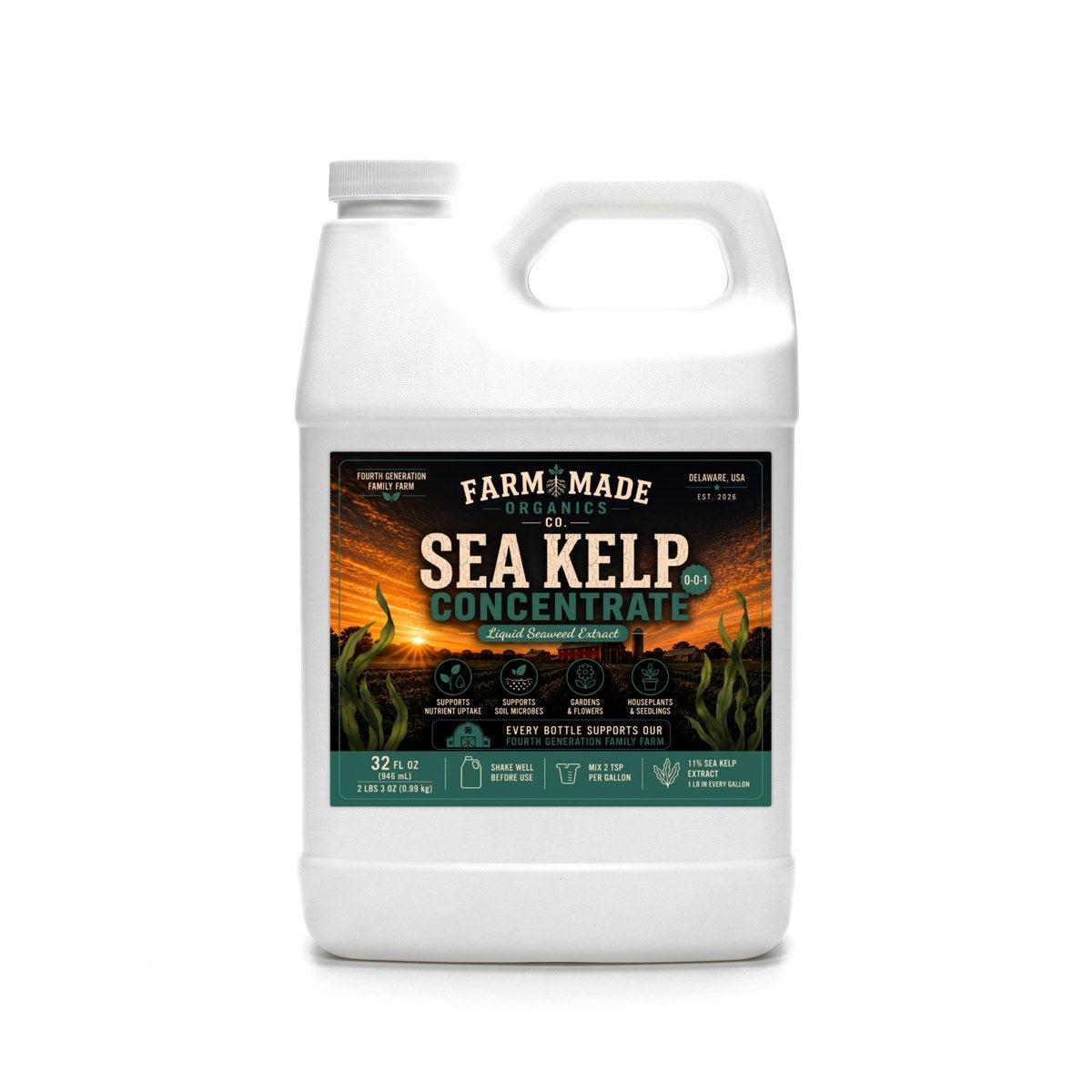
So here's ours: one full pound of Ascophyllum nodosum in every finished gallon, about 11%, with a guaranteed 1.0% soluble potash on the label. Most bottles don't publish a percentage at all.
How you'll use it
| Vegetables, flowers, containers, fruit trees | 2 tsp per gallon of water, every 2 to 4 weeks |
|---|---|
| Houseplants and seedlings | 1 tsp per gallon |
| Transplants | 1 Tbsp per gallon as a drench at planting |
| Lawns | 1 fl oz per 1,000 sq ft, monthly |
Bottled on our fourth-generation family farm in Laurel, Delaware. We publish the research that doesn't favor us, because you'll find it anyway.